Cockroach Control in Palestine, TX: What Actually Works in East Texas Homes

starts with identifying the species. German cockroaches live indoors and need gel bait plus an insect growth regulator over two to three visits. American and smokybrown cockroaches come in from mulch, tree lines, attics and crawlspaces, and need exterior perimeter treatment plus sealing entry points. Professional treatment in the Palestine area typically runs $125–$400 for a single visit, with quarterly plans around $100–$200 per visit. Over-the-counter foggers and bug bombs make German cockroach infestations worse, not better.

Anderson County sits in the Piney Woods, and that matters more than most homeowners realize. Warm nights, heavy summer humidity, pine straw and hardwood mulch against foundations, and a housing stock with plenty of pier-and-beam crawlspaces give East Texas roaches everything they need. A roach problem in Palestine is rarely a hygiene problem. It is usually a moisture problem, an entry-point problem, or a species you have misidentified.

This guide covers what works, what it costs here, where to buy products locally, and how to tell a legitimate Palestine-area pest control company from an unlicensed one.

Step 1: Identify which cockroach you have in Palestine, TX

This is the step almost everyone skips, and it is the step that decides whether treatment works. According to Texas A&M AgriLife Extension, the four species that dominate Texas structures are the German, American, Oriental and smokybrown cockroach. German cockroaches live their entire lives indoors. The other three live mostly outdoors and come inside looking for food, water or shelter.

Treating an outdoor species with indoor methods wastes money. Treating an indoor species with outdoor methods lets the population double while you wait.

SpeciesSize & lookWhere you’ll find it in a Palestine homeWhat it means
German cockroachAbout ½ inch, tan, two dark stripes behind the headKitchen cabinets, behind the fridge and dishwasher, bathroom vanities, small appliancesTrue indoor infestation. Breeds indoors year-round. Needs a bait-based program, not a spray.
American cockroach (“water bug,” “palmetto bug”)1½ inches or more, reddish-brown, pale figure-8 marking behind the headDrains, floor drains, sewer lines, crawlspaces, garages, utility roomsUsually entering from outside or from plumbing. Fix moisture and entry points first.
Smokybrown cockroach1¼–1½ inches, uniformly dark glossy mahogany, strong flierAttics, soffits, gutters, mulch beds, tree holes, woodpiles, near fireplacesAn East Texas specialty. Requires high humidity. A leaky roof or clogged gutter is often the real cause.
Oriental cockroachAbout 1 inch, glossy dark brown to black, broad body, does not flyDamp crawlspaces, drains, under-slab utility areasA moisture indicator. Drying the space out does half the work.
Brown-banded cockroachAbout ½ inch, pale bands across the wingsUpper cabinets, closets, behind picture frames, inside furniture and electronicsIndoor breeder that spreads further from the kitchen than German roaches. Often mistaken for one.

Field shortcut: if you are seeing small tan roaches with two stripes in your kitchen at night, you have a German cockroach infestation and the clock is running. If you are seeing one or two large dark roaches near a door or porch light on a humid evening, you most likely have outdoor smokybrown or American cockroaches coming in, not an indoor colony.

Step 2: Why Palestine and Anderson County homes get roaches

Local conditions that drive most of the calls we see across Palestine, Elkhart, Frankston and Tennessee Colony:

  • Humidity. Smokybrown cockroaches require high humidity to survive, which is why they thrive in the more humid parts of Texas. East Texas summers are exactly that environment.
  • Mulch and tree lines against the foundation. Ground cover, mulch, leaf litter and tree holes are prime smokybrown habitat. Branches touching the roof are a direct route into the attic.
  • Pier-and-beam crawlspaces. Older Palestine housing stock often has vented crawlspaces that stay damp. That is Oriental and American cockroach territory, and it sits directly under your floor.
  • Attics and soffits. Smokybrown cockroaches are commonly found in attics and near fireplaces, and a leaky roof will attract them.
  • Seasonal pressure. Peak summer heat and the first real cold snap both push outdoor roaches indoors. Late summer through fall is when call volume spikes here.
  • Neighboring units. In apartments, duplexes and rentals, German cockroaches move between units through shared plumbing chases. Treating one unit alone rarely holds.

Step 3: The best methods for cockroach control in Palestine, TX

Professional cockroach control is an integrated pest management (IPM) process, not a single spray. Here is the sequence that actually eliminates a population.

1. Inspection and monitoring

A technician should inspect at night or use sticky monitors placed in cabinet corners, under sinks, behind appliances and in the crawlspace. Monitors tell you the species, the population size, and — after treatment — whether the program is working. If a company quotes you without inspecting, they are guessing.

2. Moisture correction

Every roach species on this list needs water. Fix dripping traps and hose bibs, clear gutters, correct grading so water runs away from the foundation, and ventilate or dehumidify damp crawlspaces. In Anderson County this single step resolves a meaningful share of “outdoor” roach complaints.

3. Exclusion and habitat reduction

Seal gaps around plumbing penetrations under sinks, install or repair door sweeps, screen weep holes and attic vents, caulk cracks at the baseboard and cabinet line, and pull mulch and firewood back 12–18 inches from the foundation. Trim branches away from the roofline to cut off the attic route.

4. Targeted treatment by species

  • German cockroaches — gel bait plus an insect growth regulator (IGR). Gel bait is placed in dozens of small, precise spots in cracks, hinges and voids where roaches travel. The IGR breaks the breeding cycle so hatching nymphs never reach reproductive age. This is the most effective indoor method available.
  • American, Oriental and smokybrown cockroaches — exterior perimeter and void work. Perimeter treatment around the foundation, granular bait in mulch beds, dust applications in wall voids, attics and soffits, and treatment of drain and utility entry points.
  • Crawlspace and attic remediation where harborage, insulation damage or moisture is feeding the population.

5. The follow-up visit — the step that decides everything

Cockroach eggs are protected inside an egg case that most products cannot penetrate. Eggs already laid at the time of treatment will hatch afterward. A single visit almost never eliminates a German cockroach infestation. Expect a return visit roughly two weeks out, and often a third. If a company offers one visit and no re-service, you are buying a temporary reduction, not control.

What does not work

  • Total-release foggers and bug bombs. They do not reach the voids where roaches live, and the repellent action scatters German cockroaches deeper into walls and adjoining rooms. A fogged house is frequently harder and more expensive to treat afterward.
  • Spraying over your own bait. Homeowners who bait, then spray a repellent aerosol on top of it, make the bait unattractive and the whole program stalls.
  • Treating only inside when the species is an outdoor one — and treating only outside when it’s German.

Where to buy cockroach control products in Palestine, TX

If you want to try DIY first on a light, outdoor-species problem, that is a reasonable call. Here is where Palestine-area residents typically source products and what to look for.

WhereWhat you’ll findRealistic use
General retail in PalestineConsumer sprays, bait stations, boric acid dust, sticky monitorsFine for monitors and a few outdoor bait stations. Consumer sprays are the weakest option for German roaches.
Local hardware and farm & ranch supplyPerimeter granules, dusts, dusters, caulk and door sweepsGenuinely useful. Exclusion hardware often does more than any chemical you’ll buy here.
Home improvement retail in Tyler or AthensWider selection, better dust applicators and sealantsWorth the trip if you’re doing crawlspace or attic work yourself.
Online professional-grade suppliersProfessional gel baits, IGRs, bait rotation kitsThe only DIY route with a real chance against German cockroaches — if you rotate baits and place them correctly.

What to actually buy, in order of value: sticky monitors (cheap, and they tell you what you’re fighting), a quality gel bait, an IGR, a bulb duster with boric acid for voids, door sweeps and exterior-grade caulk. Skip foggers entirely.

The honest limitation: consumer baits are weaker than professional formulations, and bait aversion is a real problem — German cockroach populations can stop feeding on a bait matrix they’ve been over-exposed to. If activity hasn’t dropped sharply within three weeks, DIY isn’t going to finish it.

Step 5: Cost of cockroach extermination in Palestine and nearby Texas towns

National 2026 data puts a single professional cockroach treatment at roughly $100–$600, with most homeowners paying around $200–$275. Severe, entrenched infestations requiring fumigation or extended programs run far higher.

Palestine and the surrounding Anderson County market generally sits at or slightly below those national midpoints — rural East Texas pricing is well below metro Dallas or Houston, and dramatically below coastal-city pricing. Use the ranges below as planning figures and confirm with a written quote after inspection.

ServiceTypical Palestine, TX rangeNotes
Inspection and species IDOften free with serviceNever pay for a quote that comes without an inspection.
One-time treatment, light activity$125–$250Typically outdoor species, single-room activity.
One-time treatment, moderate$200–$400Includes interior and exterior work.
German cockroach program (2–3 visits)$300–$600 totalGel bait rotation plus IGR. The realistic path to elimination.
Quarterly maintenance plan$100–$200 per visitBest value in East Texas — covers roaches plus ants, spiders and scorpions.
Monthly plan (heavy pressure / commercial)Initial visit, then $50–$100 per monthStandard for restaurants, rentals and multi-unit properties.
Severe infestation / fumigation$1,000+Rare in single-family homes. Get a second opinion before agreeing.

What moves the price up or down

  • Species. German cockroach work costs more than American or smokybrown work because it requires multiple visits and more meticulous placement.
  • Square footage and layout. A 1,000 sq ft house and a 3,000 sq ft house are different jobs.
  • Severity and duration. A problem reported in week two costs a fraction of the same problem reported in month six.
  • Access. Crawlspace, attic and soffit work adds labor.
  • Prior DIY. Heavy repellent spraying or fogging before the call often increases the cost of the professional program.
  • Plan vs. one-time. A quarterly plan almost always costs less per year than two or three emergency one-time calls.

Step 6: How to find and vet a professional cockroach removal service in Palestine, TX

Anyone can print a truck magnet. In Texas, pest control for pay is regulated — verify before you sign.

  1. Confirm the Texas license. The Texas Department of Agriculture’s Structural Pest Control Service (SPCS) licenses structural pest control businesses and applicators.
  2. Ask for the species in writing. A company that won’t name the species on the service ticket is not running a real program.
  3. Confirm the follow-up is included. For German cockroaches, at least one return visit should be in the quoted price, not an upsell.
  4. Get the warranty terms in writing. Re-service window, what voids it, and what happens if activity returns in 30 days.
  5. Check liability insurance. Especially if crawlspace or attic work is involved.
  6. Ask about products and safety. You should get clear guidance on children, pets and re-entry timing before the technician arrives.
  7. Weigh local response time. A regional chain routing a truck from Tyler or Corsicana cannot match a Palestine-based company on same-day and next-day scheduling.
  8. Read recent local reviews — specifically ones that mention roaches and mention Palestine, Elkhart, Frankston or Crockett by name. Generic five-star reviews tell you nothing.

Cockroach problem in Palestine or Anderson County?

Infestaway Pest Control is a locally owned, Texas-licensed pest control company based in Palestine, TX. We identify the species before we treat, include the follow-up visit in German cockroach programs, and offer same-day scheduling when the route allows. We also handle crawlspace and attic remediation and wildlife removal — the two things that most often turn a “roach problem” into a recurring one.

Call +1 (903) 388-7516 or request an inspection online. Se habla español.

Cockroach control service areas around Palestine, TX

We serve homes and businesses in Palestine and across Anderson County and neighboring communities, including Elkhart, Frankston, Tennessee Colony, Montalba, Cayuga, Neches, Grapeland, Crockett, Rusk, Jacksonville, Athens, Fairfield, Buffalo and the surrounding East Texas area.

A year-round prevention calendar for East Texas

SeasonWhat’s happeningWhat to do
Spring (Mar–May)Outdoor populations build in mulch and leaf litterClear winter debris, pull mulch back from the foundation, schedule the first perimeter treatment
Summer (Jun–Aug)Peak humidity; smokybrown activity in attics and soffits; flying roaches at porch lightsClean gutters, check the roof and soffits, switch porch bulbs to warm/yellow, keep the perimeter current
Fall (Sep–Nov)First cold snaps push outdoor roaches indoors; peak call seasonDoor sweeps, seal plumbing penetrations, treat the crawlspace, stack firewood away from the house
Winter (Dec–Feb)German cockroaches keep breeding indoors regardless of temperatureSet monitors in the kitchen and baths; address any indoor sighting immediately

Frequently asked questions

How much does cockroach extermination cost in Palestine, TX?

Most Palestine-area homeowners pay $125–$400 for a single cockroach treatment, or $100–$200 per visit on a quarterly plan. A full German cockroach program of two to three visits typically totals $300–$600. National 2026 averages run $100–$600 per treatment, and rural East Texas generally sits at or below the midpoint. Species, home size, severity and access determine where you land.

Who does professional cockroach removal in Palestine, Texas?

Infestaway Pest Control is locally owned and Texas-licensed, based in Palestine and serving Anderson County including Elkhart, Frankston, Crockett and Jacksonville. Whoever you hire, confirm their Texas Department of Agriculture structural pest control license first — you can verify with TDA at (877) 542-2474.

Where can I buy cockroach control products in Palestine, TX?

Consumer sprays, bait stations, monitors and exclusion supplies are stocked at general retail and hardware stores in Palestine, with wider selection at home improvement retailers in Tyler and Athens. Professional gel baits and insect growth regulators generally come from online pest supply retailers. The highest-value purchases are monitors, gel bait, door sweeps and exterior caulk. Avoid foggers and bug bombs — they scatter German cockroaches into wall voids and make professional treatment harder and more expensive.

What actually kills roaches fastest?

For German cockroaches, gel bait combined with an insect growth regulator over two to three visits. For American, Oriental and smokybrown cockroaches, exterior perimeter treatment plus moisture correction and sealing entry points. Identify the species first — the wrong method against the wrong species wastes the entire treatment.

Why are there big flying roaches around my house in East Texas?

Those are almost always American or smokybrown cockroaches. Both can fly or glide on warm humid nights and are drawn to lights, and both live outdoors in mulch, gutters, tree holes and attics. One on the porch isn't an infestation. Repeated indoor sightings mean they've found a way in — usually a gap under a door, an unscreened attic vent, or a branch touching the roof.

How long does it take to get rid of cockroaches?

Outdoor species usually drop off within one to two weeks of a perimeter treatment. German cockroach infestations take three to six weeks and at least two visits, because eggs are protected inside a case and hatch after the first treatment. Judge progress by monitor counts, not by whether you saw one last night.

Do I have to leave the house during treatment?

For standard gel bait and crack-and-crevice work, no — bait goes into voids and cabinet interiors, not across living space. Your technician will give you re-entry and drying guidance for any liquid or dust application, plus instructions for children, pets and food prep areas. Whole-structure fumigation is the exception and does require vacating.

Does a clean house prevent roaches in Palestine, TX?

Sanitation helps, but it isn't the whole picture here. Smokybrown and American cockroaches walk into spotless homes from mulch beds, gutters, crawlspaces and attics because East Texas humidity supports them outdoors year-round. Moisture control and sealing entry points do more for a local home than cleaning alone.

Are cockroaches actually a health risk?

They move germs across food surfaces and are associated with allergies and asthma — cockroach allergens are a recognized asthma trigger in children. German cockroaches are the main concern because they live indoors in kitchens and bathrooms all year.

Should I treat roaches myself or call someone?

DIY is reasonable for a few large outdoor roaches: monitors, exterior bait, door sweeps, moisture fixes. Call a professional if you see small striped roaches in the kitchen, see roaches in daylight, find droppings or egg cases, live in a duplex or apartment, or have treated for three weeks with no clear drop in activity. Daytime sightings mean the population is large enough to push roaches out of hiding.

Still not sure what you're dealing with? Request an inspection or call +1 (903) 388-7516.
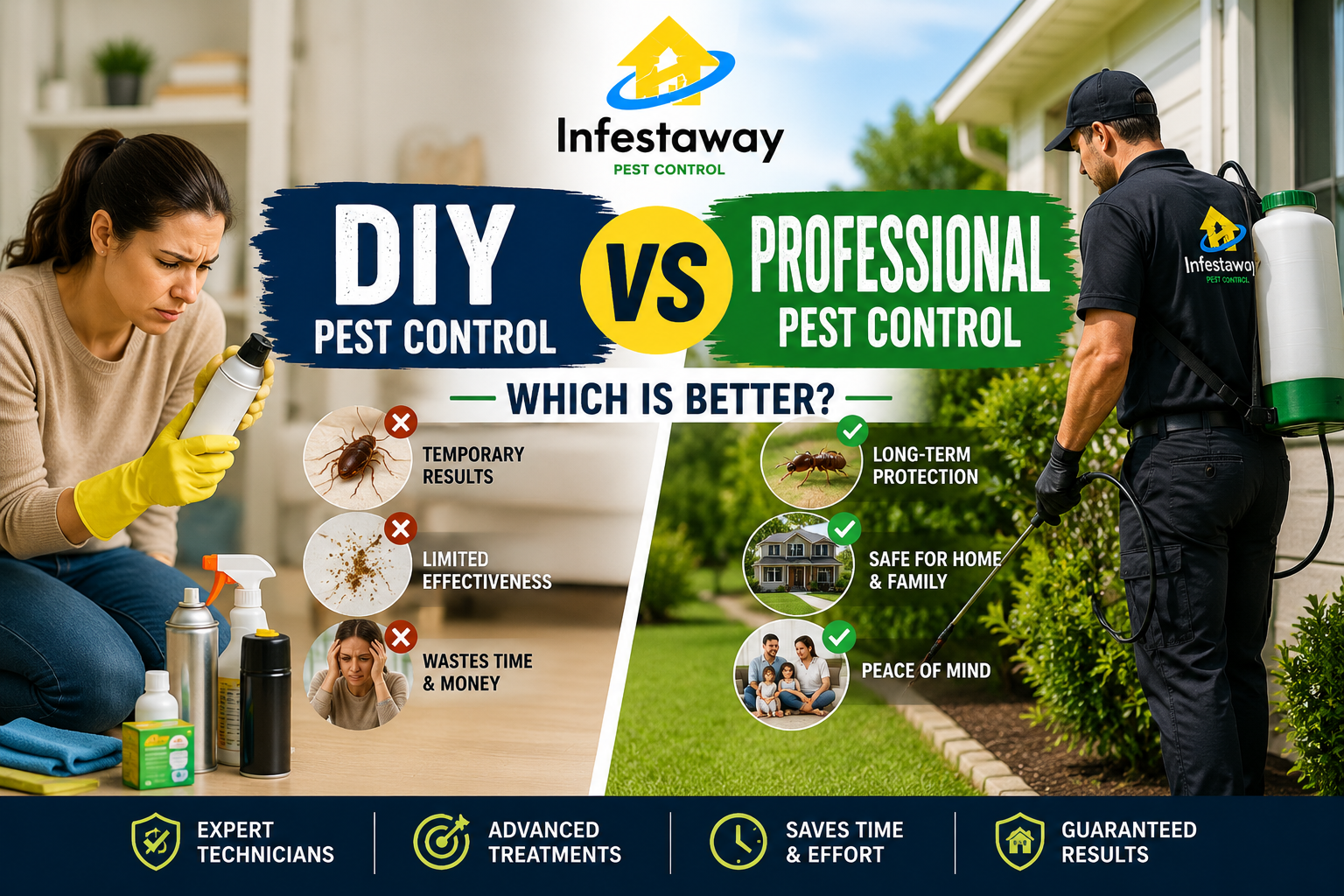
DIY Pest Control vs Professional Pest Control: Which Is Better?

Every homeowner eventually faces the same question: grab a can of spray from the hardware store, or call in a professional? This pest control comparison breaks down the real differences in cost, effectiveness, and safety between DIY pest control and professional pest control, so you can make the right call before a small problem becomes a big one.

What Is DIY Pest Control?

DIY pest control means handling infestations yourself using store-bought sprays, baits, traps, or natural remedies. It’s the go-to first step for most homeowners because it’s cheap, immediate, and doesn’t require scheduling anyone.

Common DIY tools include:

  • Aerosol insecticide sprays
  • Sticky traps and bait stations
  • Boric acid, diatomaceous earth, and other natural treatments
  • Caulk and sealant for entry points

What Is Professional Pest Control?

Professional pest control involves licensed technicians who inspect your property, identify the exact pest and its source, and apply commercial-grade treatments that aren’t available to consumers. Most services also include follow-up visits and a guarantee.

A typical professional visit includes:

  • A full property inspection (interior and exterior)
  • Species identification and nest/colony location
  • Targeted treatment using professional-strength products
  • A treatment plan and warranty for re-treatment if pests return

DIY vs Professional Pest Control: Key Differences

Factor DIY Pest Control Professional Pest Control
Upfront cost Low ($10–$50 per product) Higher ($150–$500+ per visit)
Long-term cost Adds up with repeat purchases Often bundled into a maintenance plan
Effectiveness Treats visible pests Treats the source: nests, colonies, entry points
Products used Consumer-grade, limited strength Commercial-grade, professional-only formulas
Time investment Ongoing effort, repeated applications Usually resolved in one visit
Safety Risk of misuse or overexposure Applied per safety regulations by trained techs
Guarantee None Warranty or free re-treatment
Best for Ants, minor spiders, isolated bugs Termites, rodents, bed bugs, recurring infestations

Cost Comparison: Cheaper Upfront Doesn’t Mean Cheaper Overall

DIY pest control wins on sticker price. A bottle of spray costs far less than a professional visit. But that math only holds if the DIY treatment actually works the first time.

Repeated purchases after failed treatments, plus the cost of property damage from pests DIY methods miss — termites being the clearest example — can quickly outpace what a professional would have charged upfront.

Effectiveness: Treating Symptoms vs. Solving the Problem

This is where the two approaches diverge most. DIY pest control kills what you can see. Professional pest control finds and treats what you can’t — the nest behind the wall, the colony under the slab, the entry point in the foundation.

That’s why pests treated with DIY products often reappear within weeks: the individual bugs are gone, but the source isn’t.

Safety Considerations

Store-bought pesticides are legal for consumer use, but misuse is a real risk — overapplication, mixing chemicals, or using them near children and pets without proper precautions.

Professional pest control technicians are trained in EPA-compliant application, use the correct concentration for the pest and space, and know how to keep treatments safe around households.

When DIY Pest Control Makes Sense

DIY pest control is a reasonable choice when:

  • You’re dealing with a small, isolated ant trail
  • You’ve spotted one or two spiders, not an ongoing pattern
  • You’re being preventive — sealing cracks, cleaning up food sources
  • There’s no sign of nesting, damage, or a recurring pattern

When You Should Call a Professional

Skip the DIY route and call a professional if you notice:

  • Termites or any sign of wood damage
  • Bed bugs
  • Rodents (mice or rats)
  • The same pest coming back despite DIY treatment
  • A wasp or hornet nest
  • Pest activity in a home with infants, pets, or elderly residents

Verdict: Which Is Better?

For small, isolated issues, DIY pest control is a fine first step. But for anything recurring, structural, or health-related — termites, rodents, bed bugs — professional pest control is the better choice because it treats the source of the infestation, not just the pests you can see.

How Often Should You Get Professional Pest Control?

Most homes benefit from quarterly professional treatments, with more frequent visits recommended in high-pest-pressure regions or after a confirmed infestation.

Get a Free Inspection from InfestAway Pest Control

Not sure which category your pest problem falls into? InfestAway Pest Control offers free inspections to identify exactly what you’re dealing with and whether DIY methods will actually work — or if it’s time for professional treatment.

Call InfestAway Pest Control at +1 (903) 388-7516 to schedule your free inspection.

Frequently Asked Questions (FAQs):

Is DIY pest control effective for a serious infestation?

No. DIY treatments typically only kill visible pests and don’t reach hidden nests, termite colonies, or large-scale infestations, so a professional inspection is recommended for serious problems.

Cost varies by pest type and property size, but most treatments range from $150–$500 depending on severity and whether it’s a one-time visit or an ongoing plan.

Not always. Store-bought pesticides can pose risks if misapplied, while professional technicians apply treatments according to safety guidelines that account for pets and children in the home.

Yes. Many homeowners use DIY prevention, like sealing cracks and removing food sources, alongside professional treatment for existing infestations for the best long-term results.

Signs that call for a professional include termites, bed bugs, rodents, pest activity that returns despite DIY treatment, or a nest near an entry point to the home.

Yes. Call InfestAway Pest Control at +1 (903) 388-7516 to schedule a free inspection and get a clear read on whether DIY or professional treatment fits your situation.

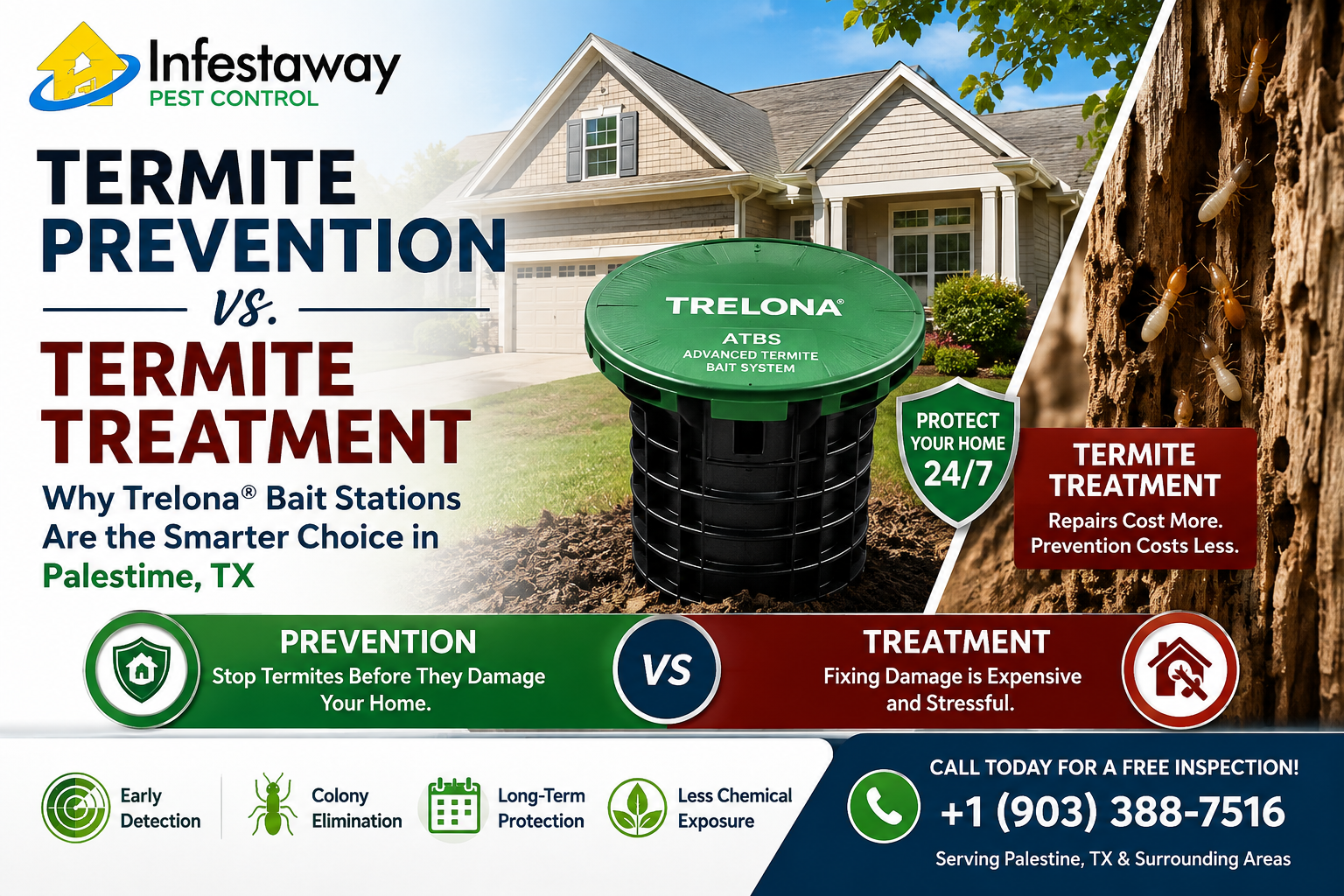
Termite Prevention vs. Termite Treatment: Why Trelona® Bait Stations Are the Smarter Choice in Palestine, TX

If you own a home in Palestine, Texas, termites are not a question of “if” — they’re a question of “when.” East Texas’ warm, humid climate and clay-rich soil create ideal conditions for subterranean termites to thrive year-round. Homeowners across Palestine, Elkhart, Frankston, Grapeland, Athens, and the surrounding Anderson County area lose thousands of dollars every year to termite damage that could have been prevented.

This raises an important question for local homeowners: should you wait until you see termite damage and then treat it, or should you invest in ongoing prevention?

At InfestAway Pest Control, we believe the answer is clear — and it starts with understanding the real difference between termite treatment and termite prevention, and why Trelona® Bait Stations have become the smarter, safer, and more cost-effective choice for termite control in Palestine, TX.

Termite Treatment vs. Termite Prevention: What’s the Difference?

Termite Treatment (Reactive Approach)

Termite treatment happens after an infestation is discovered. By the time most homeowners notice signs — hollow-sounding wood, mud tubes along the foundation, discarded wings near windowsills, or sagging floors — termites have often been active for months or even years.

Traditional treatment methods typically involve:

  • Liquid termiticide trenching around the foundation
  • Drilling into slabs or walls to inject chemicals
  • Localized spot treatments for visible damage
  • Repairs to structural damage already caused

While effective at killing existing colonies, reactive treatment is disruptive, chemical-heavy, and doesn’t guarantee new colonies won’t move in later.

Termite Prevention (Proactive Approach)

Termite prevention is about stopping colonies before they ever reach your home’s structure. Instead of waiting for damage, a prevention system continuously monitors and eliminates termite activity around your property’s perimeter — year after year.

This is exactly where Trelona Bait Stations change the game.

What Are Trelona® Bait Stations?

Trelona Advanced Termite Bait Stations (ATBS) are in-ground monitoring and baiting stations installed around the perimeter of your home. Each station contains a slow-acting bait that termite worker foragers pick up, share with the colony, and ultimately eliminate — including the queen.

How Trelona Bait Stations Work:

  1. Installation — Discreet stations are placed strategically around your home’s foundation, typically every 10–20 feet.
  2. Attraction — Termites foraging underground encounter the station and feed on the bait matrix inside.
  3. Colony Elimination — The active ingredient, Novaflumuron, disrupts the termites’ ability to molt. Because termites share food through trophallaxis, the bait spreads throughout the entire colony — not just the termites that visit the station.
  4. Ongoing Monitoring — Licensed technicians inspect and service stations regularly, so any new termite activity is caught and neutralized early, before it ever threatens your home.

Why Trelona Bait Stations Are the Smarter Choice for Palestine, TX Homeowners

1. Non-Invasive Installation

Unlike liquid trenching or slab drilling, Trelona stations are installed in the soil around your property with minimal disruption to landscaping, driveways, or your foundation.

2. Continuous, Year-Round Protection

Palestine’s climate keeps termites active nearly year-round. Bait stations provide ongoing monitoring, not a one-time chemical barrier that can break down or develop gaps over time.

3. Whole-Colony Elimination

Because Trelona targets the entire colony — including the reproductive queen — it addresses the root of the problem rather than just the termites you can see.

4. Environmentally Responsible

Trelona bait stations use significantly less active ingredient than full-perimeter liquid treatments, making them a lower-impact option for households with children, pets, gardens, or wells.

5. Lower Long-Term Cost

Preventing termite damage is almost always less expensive than repairing it. Structural termite damage repairs in East Texas can easily run into the thousands of dollars — a cost that’s completely avoidable with a proactive baiting program.

6. Ideal for Palestine’s Soil and Climate

Anderson County’s clay soils retain moisture, which is exactly what subterranean termite colonies need to survive. That makes in-ground bait stations especially effective here compared to drier regions of the state.

Signs You May Need Termite Control in Palestine, TX

Even with prevention in place, it’s worth knowing what to watch for:

  • Mud tubes running along your foundation, crawl space, or exterior walls
  • Discarded termite wings near doors or windows
  • Wood that sounds hollow when tapped
  • Tight-fitting doors or windows caused by warped frames
  • Small pinholes or blistering in painted wood surfaces

If you notice any of these signs in your Palestine, Frankston, Elkhart, Grapeland, or Athens home, don’t wait — early intervention makes a significant difference in the cost and complexity of treatment.

Prevention Beats Treatment — Every Time

Think of it like this: treating an active termite infestation is like putting out a fire. Prevention with Trelona Bait Stations is like never letting the spark happen in the first place. For Palestine, TX homeowners, that means:

  • No surprise structural repairs
  • No repeated chemical treatments
  • Continuous peace of mind backed by professional monitoring
  • Protection tailored to East Texas’ termite pressure

Get Reliable Termite Control in Palestine, TX with InfestAway Pest Control

At InfestAway Pest Control, we help homeowners throughout Palestine, TX and surrounding communities protect their biggest investment with proven, professional-grade termite solutions — including Trelona Advanced Termite Bait Stations. Our licensed technicians design a monitoring and prevention plan tailored to your property, your soil, and your home’s specific risk factors.

Whether you’re dealing with visible termite damage today or want to prevent it from ever happening, our team is ready to help.

Don’t wait for termites to make the decision for you.

📞 Call InfestAway Pest Control today: +1 (903) 388-7516

Protecting homes in Palestine, TX and the surrounding East Texas communities — one bait station at a time.

Frequently Asked Questions:

How much does termite control cost in Palestine, TX?

Costs vary depending on your home’s size, soil conditions, and whether active infestation is present. InfestAway Pest Control offers free inspections and custom quotes for Palestine-area homeowners.

Yes. Trelona stations are installed underground and use a targeted amount of active ingredient, making them one of the lowest-impact termite control options available.

InfestAway technicians typically service and inspect stations on a regular schedule to catch termite activity early and keep the bait matrix effective.

Liquid treatments can kill termites on contact faster, but bait stations are designed to eliminate the entire colony over time — offering a more complete, long-term solution.

Have more questions? Call InfestAway Pest Control at +1 (903) 388-7516

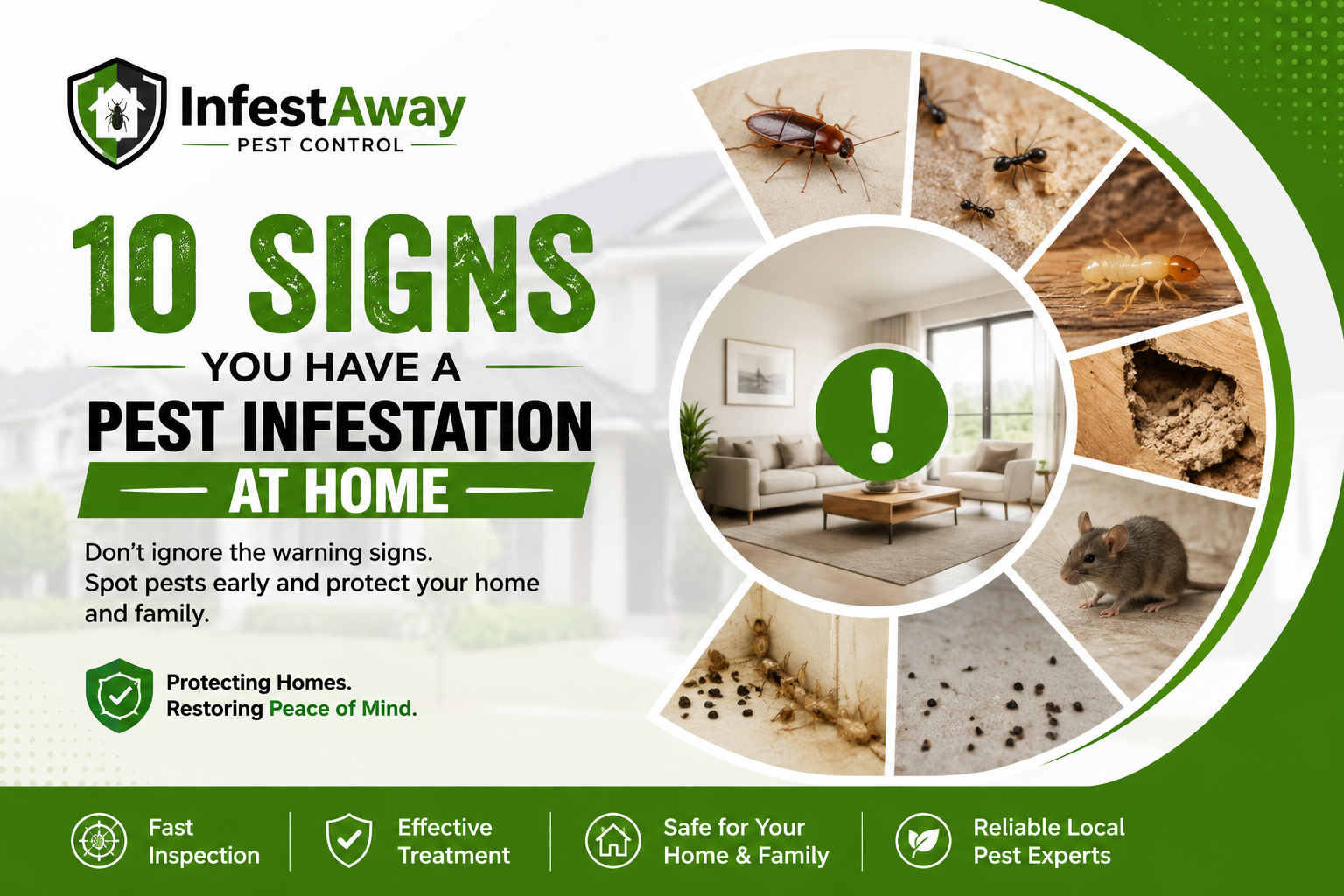
10 Signs You Have a Pest Infestation at Home (Palestine, TX Homeowner’s Guide)

East Texas homes have the perfect combination of humidity, mild winters, and mature tree cover that pests love. If you live in Palestine, Frankston, Elkhart, Grapeland, or anywhere else in Anderson County, chances are you’ve dealt with — or will deal with — some kind of household pest sooner or later. The tricky part is that most infestations don’t announce themselves. By the time you actually see a roach scurry across your kitchen floor or spot a mouse in the pantry, the problem is usually already bigger than it looks.

Knowing the early warning signs of pests can save you money, protect your home’s structure, and keep your family healthier. Below are the 10 most reliable signs of a pest infestation, what they usually mean, and when it’s time to call a professional pest control company.

1. Droppings in Cabinets, Drawers, or Along Baseboards

Droppings are one of the clearest and most common signs of an infestation. Rodent droppings are small, dark, and pellet-shaped, often clustered near food sources, under sinks, or along walls where rodents travel. Roach droppings look more like ground coffee or black pepper and tend to collect in corners, behind appliances, and inside cabinets.

If you’re finding unexplained debris in your kitchen or pantry, don’t just clean it up and move on — it’s worth investigating further, because droppings almost always mean there are more pests hiding than you can see.

2. Gnaw Marks on Wood, Wires, or Food Packaging

Rodents like mice and rats have teeth that never stop growing, so they chew constantly to keep them filed down. This means gnaw marks on baseboards, cabinet corners, cardboard boxes, or even electrical wiring are a strong red flag. Chewed wiring is especially concerning because it’s a fire hazard, not just an inconvenience.

If you notice torn cereal boxes, chewed plastic containers, or small holes in food packaging, treat it as a sign that rodents have already found a reliable food source in your home.

3. Strange Noises in the Walls or Attic

Scratching, scurrying, or tapping sounds coming from your walls, ceiling, or attic — especially at night — are a classic sign of rodents or, in some cases, squirrels that have found their way into your home’s structure. Palestine’s older homes and homes near wooded lots are particularly prone to this, since gaps around rooflines and soffits give animals easy entry points.

If the noise seems to move or you hear it consistently around the same time each night, it’s worth having a professional inspect your attic, eaves, and crawl space.

4. Unusual Odors

Pests often leave behind distinct smells that are easy to overlook until they build up. A musty, oily odor can indicate a large cockroach population, while a strong ammonia-like smell is often linked to rodent urine concentrated in one area, like an attic or wall void. Termite infestations can sometimes produce a faint moldy or damp-wood smell as they damage structural wood from the inside out.

If a room smells “off” and you can’t pinpoint why, don’t ignore it — odors are often one of the earliest signs of an infestation that hasn’t become visible yet.

5. Damaged or Hollow-Sounding Wood

Termites are one of the most damaging pests homeowners in Texas deal with, largely because their damage happens out of sight. Wood that sounds hollow when tapped, sags unexpectedly, or crumbles more easily than it should can point to termite activity. You might also notice small holes, blistered paint, or wood that looks slightly warped.

Because termite damage progresses quietly and can compromise a home’s structural integrity over time, this is one sign that almost always warrants a professional termite inspection rather than a wait-and-see approach.

6. Mud Tubes Near the Foundation

Speaking of termites, subterranean termites — the most common species in East Texas — build pencil-thin mud tubes along foundations, exterior walls, or crawl space piers to travel between the soil and their food source (your home’s wood) while staying protected from open air. If you spot these narrow, dirt-colored tubes running vertically along your foundation, it’s a near-certain sign of termite activity and calls for immediate attention.

7. Nests or Nesting Materials

Rodents build nests out of shredded paper, fabric, insulation, or dried plant material, usually tucked into quiet, undisturbed areas like attics, wall voids, behind appliances, or inside storage boxes. Finding a nest — even an old, abandoned one — is a sign that pests have not only entered your home but have been comfortable enough to settle in.

Wasps and other stinging insects also build visible nests under eaves, in sheds, or in tree branches around the yard, which is especially common during the warmer months in Anderson County.

8. Grease Marks or Smudges Along Walls

Rodents tend to travel the same paths repeatedly, and the natural oils in their fur leave behind dark, greasy smudge marks along baseboards, walls, and entry points over time. These marks are subtle but telling — if you notice a dark smear low on a wall near a corner or gap, it’s likely a rodent runway.

9. Visible Pests, Even Just One or Two

It’s tempting to assume that seeing a single bug or rodent is a fluke, especially if your home is otherwise clean. In reality, most pests are far better at hiding than at being seen, which means spotting even one cockroach, mouse, or ant trail during the day (when many pests are normally nocturnal) usually signals a larger population nearby.

This is especially true for cockroaches. Seeing them during daylight hours often means the hidden population has grown large enough that some individuals are being pushed out to forage.

10. Damaged Insulation or Unexplained Allergy Flare-Ups

Shredded, flattened, or displaced insulation in the attic is a common sign of rodent nesting activity, since they burrow into it for warmth. Separately, if family members start experiencing unexplained allergy symptoms, asthma flare-ups, or skin irritation, it could be linked to dust mites, cockroach droppings, or rodent dander — all of which are known allergy and asthma triggers that build up gradually as an infestation grows.

Why Pest Infestations Are So Common Around Palestine, TX

Anderson County’s mix of wooded lots, humid summers, and mild winters creates ideal conditions for pests year-round. Homes near the Davy Crockett National Forest or along rural properties in Frankston, Slocum, or Elkhart are especially prone to rodent and termite activity due to nearby wood, moisture, and natural cover. Even homes within Palestine’s city limits aren’t immune — older housing stock, mature trees, and proximity to creeks and drainage areas all create easy access points for common regional pests, including:

  • German and American cockroaches
  • Subterranean termites
  • House mice and roof rats
  • Fire ants
  • Wasps and hornets
  • Spiders, including brown recluse

What to Do If You Notice These Signs

If you’ve spotted one or more of these warning signs in your home, the most important thing is not to wait. Pest populations grow quickly, and problems like termite damage or rodent-chewed wiring can turn into expensive repairs the longer they go unaddressed. A professional inspection can identify exactly what you’re dealing with, how widespread it is, and the safest, most effective treatment plan for your specific situation.

Infestaway Pest Control proudly serves Palestine, TX and the surrounding communities, including Frankston, Elkhart, Grapeland, Slocum, and Neches. Our local technicians know the specific pest pressures East Texas homes face and provide thorough inspections, targeted treatments, and ongoing prevention plans to keep your home protected year-round.

Frequently Asked Questions:

How quickly can a pest infestation get out of control?

No. DIY treatments typically only kill visible pests and don’t reach hidden nests, termite colonies, or large-scale infestations, so a professional inspection is recommended for serious problems.

Cost varies by pest type and property size, but most treatments range from $150–$500 depending on severity and whether it’s a one-time visit or an ongoing plan.

Not always. Store-bought pesticides can pose risks if misapplied, while professional technicians apply treatments according to safety guidelines that account for pets and children in the home.

Yes. Many homeowners use DIY prevention, like sealing cracks and removing food sources, alongside professional treatment for existing infestations for the best long-term results.

Noticing any of these signs in your home? Contact Infestaway Pest Control today for a professional inspection and a customized treatment plan built for Palestine, TX homes.

Call Now or Book Online – Don’t wait until pests take over. Get your FREE inspection today!

Call +1 (903) 388-7516

Bed Bug Exterminator in Palestine, TX: What to Expect From Inspection to Treatment

If you’ve found bites, blood spots on your sheets, or tiny reddish-brown bugs near your mattress seams, you’re probably searching for a bed bug exterminator near me right now. Here’s the short answer: a professional bed bug exterminator inspects your home to confirm and map the infestation, then applies a targeted treatment — usually heat, chemical, or a combination of both — followed by a return visit to confirm the bugs are gone. The full process typically takes one to three visits over 2–4 weeks.

Below, we walk through exactly what happens at each stage, so you know what to expect when you call InfestAway Pest Control for bed bug treatment in Palestine, TX and the surrounding area.

Why Bed Bugs Are a Professional-Only Problem

Bed bugs aren’t a niche issue — more than 8 in 10 U.S. pest control professionals treated an active bed bug infestation in the past year, according to a 2025 survey by the National Pest Management Association and the University of Florida.¹ That scale exists because bed bugs are exceptionally good at hiding and exceptionally bad candidates for DIY control.

Store-bought sprays and foggers only kill the bugs they directly touch. Bed bugs hide deep in mattress seams, baseboards, outlets, and furniture joints — and according to the EPA, they will readily travel 5 to 20 feet from a hiding spot to reach a host, then return to a different crack or crevice afterward.² That means a fogger limited to one room can miss an infestation that’s already spread to the wall behind your headboard or the outlet across the room. Any bugs that survive simply relocate and keep breeding, which is the single biggest reason DIY treatments fail and infestations come back larger than before.

A licensed Bed Bug Exterminator in Palesatine uses tools and products that aren’t available to consumers — including professional-grade heat equipment, residual insecticides labeled specifically for bed bugs, and inspection techniques (like checking seams with a flashlight and credit card, or using interceptor traps) that catch evidence most homeowners miss entirely.

How Bed Bugs Spread Through a Home

Understanding how bed bugs move helps explain why a single-room treatment often isn’t enough:

  • They’re expert hitchhikers, riding in on luggage, used furniture, and clothing.
  • Once inside, they crawl at roughly 3–4 feet per minute on smooth surfaces — fast enough to travel between rooms overnight.
  • In apartments and multi-room homes, they can move through wall voids and electrical outlets into adjoining units or bedrooms.

This is exactly why a thorough inspection — not just a spot-treatment — is the foundation of every effective bed bug job.

What to Expect During a Bed Bug Inspection

Every professional bed bug treatment starts with an inspection. Here’s what that visit looks like:

  1. Interview — Your technician asks where you’ve noticed bites, when symptoms started, and whether you’ve traveled, bought used furniture, or had overnight guests recently. This narrows down likely entry points.
  2. Visual inspection — The technician checks mattress seams, box springs, bed frames, headboards, baseboards, electrical outlets, and upholstered furniture for live bugs, shed skins, eggs, and the small dark fecal spots bed bugs leave behind.
  3. Adjacent rooms — Bed bugs spread to nearby rooms and shared walls, so the inspection isn’t limited to the bedroom where symptoms first appeared.
  4. Severity assessment — Based on what’s found, the technician classifies the infestation as light, moderate, or heavy. This determines which treatment method (or combination) makes sense.
  5. Treatment plan and quote — You’ll get a written plan explaining the recommended method, number of visits, prep instructions, and cost before any treatment begins.

Most inspections take 20–45 minutes depending on the size of the home.

What to Expect During Bed Bug Treatment

Once you approve the plan, treatment usually follows this sequence:

Step 1: Prep

You’ll be given a checklist — typically washing and heat-drying bedding and clothing, decluttering the room, and vacuuming. Good prep significantly improves treatment success, so don’t skip it.

Step 2: Treatment Application

Depending on severity and your preference, your technician will use one or both of these methods.

Heat TreatmentChemical Treatment
How it worksRaises room air temperature to 135–145°F so every hiding spot reaches a lethal core temperature, no matter how deep bugs are hiddenEPA-approved residual insecticides applied to cracks, crevices, baseboards, and other harborage points
SpeedOften resolves a light-to-moderate infestation in a single visit (a few hours)Usually needs a follow-up visit 10–14 days later to catch newly hatched eggs
Best forHeavy infestations, items that can’t be easily moved or baggedLighter infestations, ongoing residual protection against re-infestation
Chemical exposureNone — heat onlyLow-toxicity, EPA-registered products applied to targeted areas only
Typical visits1, occasionally 22–3

Many infestations respond best to a combined approach: heat for an immediate knockdown, plus a chemical residual barrier to prevent re-infestation.

Step 3: Follow-Up Visit

Around two weeks after the initial treatment, your exterminator returns to check interceptor traps and inspect previous hot spots for any remaining activity. If signs of bed bugs are still present, a touch-up treatment is applied at no extra charge under most service plans.

Step 4: Confirmation

Once no new activity is found for a set monitoring period, your technician confirms the infestation is resolved and gives you prevention tips to keep bed bugs from coming back.

How Long Does Bed Bug Treatment Take?

A single heat treatment can eliminate a light-to-moderate infestation in one visit, but most professional plans build in a follow-up around the two-week mark to catch eggs that survived the first round. Full resolution — from first inspection to confirmed clearance — generally takes 2 to 4 weeks.

How Much Does a Bed Bug Exterminator Cost in Palestine, TX?

Cost depends on the size of the infested area, severity, and method used. Chemical treatments are generally less expensive per visit but may require more follow-ups; heat treatments cost more upfront but often resolve the problem faster. InfestAway provides a free inspection and a written quote before any work begins, so you know the full cost up front — no surprise charges.

Signs You Need to Call a Bed Bug Exterminator in Palesatine and nearby!

  • Small, itchy welts in a line or cluster, often on arms, legs, or torso
  • Tiny rust-colored spots on sheets or mattress seams (fecal stains)
  • Pale yellow shed skins near the mattress or bed frame
  • A musty, sweet odor in a heavily infested room
  • Live bugs about the size and shape of an apple seed

If you notice two or more of these signs, it’s time to schedule an inspection rather than wait for the problem to spread to other rooms.

Why Choose a Local, Licensed Bed Bug Exterminator in Palesatine and nearby!

Any pest control company can spray for bed bugs, but a locally based, licensed operator brings two advantages a national call-center brand often can’t: faster response times in Palestine and the surrounding towns, and first-hand familiarity with how East Texas housing stock (older wood-frame homes, mobile homes, multi-unit rentals) affects where bed bugs hide and how heat or chemical treatments perform in our climate. Always confirm your exterminator is licensed through the Texas Department of Agriculture’s Structural Pest Control Service before booking.

Serving Palestine, TX and the Surrounding Area

InfestAway Pest Control provides bed bug inspection and treatment for homes and businesses throughout Palestine, TX, and nearby communities including Tyler, Athens, Corsicana, Rusk, Canton, Buffalo, Elkhart, Oakwood, Montalba, and Ben Wheeler. Our licensed technicians are familiar with how East Texas’s climate and housing styles affect bed bug activity, and we tailor every treatment plan to your specific property.

Frequently Asked Questions

What does a bed bug exterminator actually do?

A bed bug exterminator inspects your property to confirm an infestation and identify hiding spots, then applies heat and/or chemical treatment to eliminate bed bugs at every life stage, followed by a check-up visit to confirm the problem is resolved.

Is professional bed bug treatment safe for kids and pets?

Yes. Licensed exterminators use EPA-approved products applied according to label instructions, and heat treatments involve no chemicals at all. Your technician will tell you exactly when it’s safe to re-enter treated rooms.

Can I just treat one room, or do bed bugs spread through the whole house?

Bed bugs can travel through wall voids, electrical outlets, and shared furniture, so adjacent rooms — especially in apartments — should always be inspected even if symptoms only appear in one bedroom.

How do I know if bed bug treatment worked?

Your exterminator will use interceptor traps and follow-up inspections over 2–4 weeks to confirm no new activity. No bites, no live bugs, and no fresh fecal spots during that monitoring period typically mean the treatment was successful.

Do I need to throw away my mattress if I have bed bugs?

Usually not. A properly treated mattress (heat or chemical, plus a certified bed bug encasement) can be saved in most cases. Replacement is typically only necessary for mattresses that are severely damaged or deeply infested.

Is heat treatment or chemical treatment better for bed bugs?

Neither is universally “better” — heat treatment usually resolves an infestation faster and uses no chemicals, while chemical treatment costs less upfront and leaves a residual barrier against re-infestation. Many professionals recommend combining both for the most reliable result.

Ready to Get Rid of Bed Bugs for Good?

DIY sprays only push bed bugs deeper into hiding. If you’re in Palestine, TX or a nearby town, InfestAway Pest Control offers a free inspection and a clear, upfront treatment plan — so you can stop guessing and start sleeping bite-free again. Call +1(903) 388-7516 to schedule your bed bug inspection today.

Why Cockroaches Are So Common in Palestine, TX Homes (And How to Stop Them)

If you’ve ever walked into your kitchen late at night, flicked on the light, and watched a cockroach disappear into a crack in the wall — you’re not alone. Cockroach infestations are one of the most reported pest problems in Palestine, TX, and the surrounding East Texas area. And there’s a very real reason why.

Palestine’s climate, geography, and local housing conditions create a near-perfect environment for roaches to thrive. Whether you’re a long-time resident or just moved to Anderson County, understanding why cockroaches are so common here — and how to stop them — can save you serious stress, money, and health risks.

At InfestAway Pest Control, we’ve helped hundreds of Palestine homeowners reclaim their homes from cockroach infestations. This guide breaks down everything you need to know about cockroach control Palestine, TX.

Why Palestine, TX Is a Hotspot for Cockroach Infestations

1. The East Texas Climate Is Basically a Roach Paradise

Palestine sits in Anderson County in East Texas — a region known for warm, humid summers and mild winters. Average summer temperatures regularly climb into the 90s, and the area receives generous annual rainfall. That combination of heat and moisture is exactly what cockroaches need to reproduce and thrive.

Unlike colder states where roaches go dormant in winter, East Texas cockroaches are active virtually year-round. The mild winters mean populations never fully die off between seasons. By the time summer rolls around, even a small infestation can explode into a full-blown problem.

2. Older Housing Stock Creates More Entry Points

Palestine has a rich history, and many homes in the area — from the Dogwood neighborhoods to surrounding rural properties — were built decades ago. Older construction means more cracks in foundations, gaps around pipes, aging weatherstripping, and deteriorating door seals. Cockroaches can squeeze through a gap as thin as 1/16 of an inch. Any of these small openings serve as an open door.

3. Wooded Surroundings Bring Roaches Closer to Home

East Texas is famous for its dense pine and hardwood forests — beautiful to look at, but a natural habitat for several cockroach species. Leaf piles, wood stacks, mulch beds, and overgrown vegetation around Palestine homes serve as outdoor cockroach colonies waiting for the right moment to move indoors. When temperatures spike or heavy rainfall hits, they head straight for your home.

4. Moisture-Heavy Infrastructure

Palestine’s sewer lines, drainage ditches, and older plumbing systems provide the moisture and shelter that cockroaches need to nest underground and travel indoors through pipes and drains. American cockroaches, one of the most common species in Palestine, are notorious for coming up through bathroom drains and under kitchen sinks.

The 4 Most Common Cockroaches Found in Palestine, TX

Knowing which species you’re dealing with matters — it affects where you’ll find them and how to treat them.

1. American Cockroach (Periplaneta americana)

Size: Up to 1.5–2 inches | Color: Reddish-brown

The largest cockroach you’ll encounter in Palestine homes. They prefer warm, moist areas — think sewers, basements, crawl spaces, and around HVAC units. They can fly and are often spotted near exterior lights at night during hot months. Most homeowners encounter these in bathrooms and kitchens after they travel up through drains.

2. German Cockroach (Blattella germanica)

Size: ½ inch | Color: Light brown with two dark stripes

The most dangerous infestation you can have. German cockroaches reproduce extremely rapidly — a single female can produce tens of thousands of offspring in a year. They live almost exclusively indoors, nest in kitchen cabinets, behind appliances, and inside wall voids. If you see German roaches during the day, your infestation is already severe.

3. Smoky-Brown Cockroach (Periplaneta fuliginosa)

Size: 1–1.5 inches | Color: Dark mahogany-brown

Very common in East Texas. They live outdoors in wooded areas but easily migrate indoors. They’re strong fliers and are attracted to light at night. Frequently found along the Gulf Coast region and neighboring East Texas counties surrounding Palestine.

4. Oriental Cockroach (Blatta orientalis)

Size: 1 inch | Color: Dark brown to black

Often called “water bugs,” these roaches thrive in cool, damp basements, drains, and utility areas. They’re slower movers and don’t fly, but they carry a significant bacterial load and are associated with a strong, musty odor.

📞 Call us today for a FREE inspection : +1 (903) 388-7516

Health Risks: Why You Shouldn’t Ignore a Roach Problem

Cockroaches aren’t just an “ick” factor — they represent a genuine public health concern, especially for families with children, elderly residents, or anyone with respiratory conditions.

Here’s what a cockroach infestation can do to your home and health:

  • Spread bacteria and pathogens — Cockroaches pick up E. coli, Salmonella, and dozens of other bacteria from sewers and waste, then track them across your kitchen surfaces and food prep areas.
  • Trigger asthma and allergies — Roach droppings, shed skins, and saliva are known allergens. Children living in heavily infested homes are significantly more likely to develop asthma.
  • Contaminate food supplies — They consume and soil pantry goods, pet food, and even cardboard packaging.
  • Damage your home — Cockroaches chew on books, paper, fabric, and even electrical wiring insulation — creating fire hazards in extreme cases.

The bottom line: If you spot one cockroach, there are likely dozens or hundreds more hidden out of sight. Acting fast with professional roach control in Palestine, TX is always the smarter and cheaper option compared to waiting until the infestation scales.

7 Reasons Cockroaches Keep Coming Back to Palestine Homes

Even if you’ve sprayed or used store-bought products before, you may have noticed the roaches always seem to return. Here’s why:

  1. You killed the visible ones but missed the nest — Over-the-counter sprays kill roaches on contact but don’t penetrate deep nesting areas inside walls, under slabs, or inside appliances.
  2. Fogging and bombing don’t reach hiding spots — Cockroach bombs push roaches deeper into cracks and voids rather than eliminating the colony.
  3. Egg sacks (oothecae) survive treatments — Female cockroaches carry egg cases that are highly resistant to many common pesticides. If eggs aren’t eliminated, the cycle restarts.
  4. Entry points weren’t sealed — Without sealing cracks, gaps, and pipe penetrations, new roaches from outdoors simply re-enter your home.
  5. Moisture issues weren’t fixed — Leaky pipes, high humidity, and standing water continue to attract roaches even after treatment.
  6. No prevention plan was in place — One-time treatments without a follow-up schedule often result in re-infestation within weeks or months.
  7. Neighbors or shared walls — In apartment buildings or closely spaced housing, roaches travel from unit to unit through shared walls and plumbing.

📞 Call us today for a FREE inspection : +1 (903) 388-7516

How to Stop Cockroaches in Your Palestine, TX Home: A Step-by-Step Guide

1: Eliminate Food and Water Sources

  • Store all food (including pet food) in sealed, airtight containers.
  • Empty trash cans daily and use bins with tight-fitting lids.
  • Fix leaky faucets, pipes, and appliances immediately.
  • Don’t leave dishes soaking in the sink overnight.
  • Clean under the refrigerator, stove, and dishwasher regularly — crumbs and grease are roach fuel.

2: Reduce Clutter and Hiding Spots

  • Declutter stacks of paper, cardboard, and bags — cockroaches love to nest in these.
  • Remove cardboard boxes from garages, closets, and storage areas (roaches love cardboard).
  • Keep your garage, attic, and crawl space clean and well-ventilated.

3: Seal Entry Points

  • Caulk all gaps around pipes, drains, baseboards, and wall penetrations.
  • Install weatherstripping on doors and repair damaged window screens.
  • Check the seals around your dryer vent, HVAC lines, and utility entry points.
  • Place drain covers on floor drains in bathrooms, laundry rooms, and basements.

4: Address Outdoor Harborage Areas

  • Move firewood, mulch, and leaf piles away from the foundation of your home.
  • Trim back vegetation and overgrown shrubs that touch your home’s exterior.
  • Clean gutters regularly to eliminate standing water and debris.
  • Check your outdoor garbage cans for roach activity.

5: Call InfestAway Pest Control for Professional Treatment

DIY measures are a helpful complement, but they rarely eliminate an established cockroach infestation. A professional cockroach control Palestine, TX is the only reliable way to locate and destroy the nest, treat egg sacks, and set up a prevention plan that actually works long-term.

📞 Call us today for a FREE inspection : +1 (903) 388-7516

Why Professional Cockroach Control Beats DIY Every Time

Here’s the honest truth that most DIY guides won’t tell you: store-bought products were designed to be safe enough for consumers to use, not powerful enough to eliminate colonies. That’s a meaningful difference.

At InfestAway Pest Control, our licensed technicians use:

  • Targeted gel baits that cockroaches carry back to the nest, eliminating the colony from within
  • Residual liquid treatments applied to harborage zones, cracks, and voids
  • Insect Growth Regulators (IGRs) that disrupt the cockroach reproductive cycle and prevent eggs from hatching
  • Comprehensive inspections to identify every nesting location, moisture source, and entry point
  • Scheduled follow-up treatments to ensure the infestation is completely resolved — not just knocked back temporarily

We don’t just spray the surface. We treat the source.

InfestAway’s Cockroach Control Process in Palestine, TX

When you call InfestAway Pest Control, here’s what you can expect:

1. Free Inspection Our technician performs a thorough walk-through of your home — inside and outside — to assess the extent of the infestation and identify species, nesting sites, and entry points.

2. Customized Treatment Plan Every home is different. We create a treatment plan tailored to your specific situation, home layout, and the cockroach species involved.

3. Professional Treatment We apply a combination of targeted treatments designed for maximum effectiveness while keeping your family and pets safe.

4. Follow-Up and Prevention We schedule return visits to monitor activity, address any new sightings, and apply additional treatments as needed. We also provide you with a written prevention plan to keep roaches from coming back.

5. Satisfaction Guarantee Your peace of mind matters. If cockroaches return between scheduled treatments, so do we — at no extra charge.

📞 Call us today for a FREE inspection : +1 (903) 388-7516

Frequently Asked Questions

Very quickly. German cockroaches reproduce at an alarming rate. What starts as a few roaches can become hundreds within weeks.
Cockroaches themselves aren’t typically dangerous, but the bacteria they carry and improper DIY treatments can be harmful.
Most clients notice a reduction in activity within 1–2 weeks. Severe infestations may require follow-up treatments.
In most cases, you may need to leave for 2–4 hours while treatments are applied and dried.
Yes. Preventive treatments and sealing entry points can significantly reduce your risk of infestation.

Serving Palestine and All of Anderson County, TX

InfestAway Pest Control is proud to serve homeowners and businesses throughout the Palestine area, including:

  • Palestine, TX (Anderson County Seat)
  • Frankston, TX
  • Elkhart, TX
  • Neches, TX
  • Westwood Shores, TX
  • Cayuga, TX
  • Montalba, TX
  • And surrounding East Texas communities

Whether you’re dealing with a full-blown German roach infestation in your kitchen or American cockroaches coming up through your drains, InfestAway has the local expertise to solve the problem fast.

Don’t Wait — Cockroaches Won’t Go Away on Their Own

Every day you wait, cockroaches reproduce, spread, and dig deeper into your home. In East Texas’s warm climate, there is no “off season” for roach activity. The longer an infestation grows, the harder — and more expensive — it becomes to eliminate.

The good news? InfestAway Pest Control makes it easy to get started.

📞 Call us today for a FREE inspection and same-week service in Palestine, TX : +1 (903) 388-7516

Top 10 Common Pests In Palestine

Pest Control

Living in Palestine, TX means warm summers, beautiful Piney Woods scenery — and unfortunately, a year-round battle with Pests in Palestine. East Texas’s humid subtropical climate creates the perfect breeding ground for dozens of pest species that can damage your home, threaten your family’s health, and make outdoor living miserable.

Whether you’re dealing with fire ants taking over your backyard or termites silently destroying your home’s structure, this guide covers the 10 most common pests in Palestine and Anderson County — what to look for, why they’re dangerous, and how to get rid of them.

1. Fire Ants

Risk Level: High | Peak Season: Year-Round | Where: Lawns, Gardens, Driveways

If you’ve lived in Palestine for more than a season, you already know fire ants. Red imported fire ants (Solenopsis invicta) are arguably the number one pest complaint in all of Anderson County. Their mounds appear overnight in lawns, parks, playgrounds, and driveways — and when disturbed, thousands of aggressive ants swarm and sting within seconds.

The sting causes an intense burning sensation and white pustules that can last for days. For children, elderly residents, and people with allergies, fire ant stings can trigger life-threatening anaphylactic reactions.

How to Get Rid of Fire Ants:

  • Apply broadcast bait treatments across your yard in spring and fall for colony-wide control
  • Treat individual mounds with a liquid insecticide drench
  • Avoid the hot water method — it rarely kills the queen and can burn you
  • Professional quarterly treatments are the most effective long-term solution in Palestine’s climate

2. Termites

Risk Level: Critical | Peak Season: Spring–Summer | Where: Wood structures, Foundation, Crawlspaces

Termites cause an estimated $5 billion in property damage across the U.S. every year, and East Texas is one of the most termite-active regions in the country. Palestine’s moist soil is ideal for subterranean termites, and Formosan termites — even more destructive — are increasingly common in Anderson County. The terrifying truth: by the time you notice visible damage, termites may have been feeding on your home for months or even years.

Warning signs to watch for: mud tubes on foundation walls, hollow-sounding wood when tapped, warped doors or floors, and discarded wings near windows in spring.

How to Get Rid of Termites:

  • Schedule annual termite inspections — every Palestine homeowner should have one
  • Liquid termiticide barriers (such as Termidor) create a protective zone around your foundation
  • Termite bait station systems disrupt and eliminate colonies over time
  • Never attempt to treat termites yourself — gaps in DIY treatment allow rapid re-infestation

3. Cockroaches

Risk Level: High | Peak Season: Year-Round | Where: Kitchens, Bathrooms, Walls

Palestine homes deal with two main types: American cockroaches (the large reddish-brown “Palmetto bugs” that come in from outside) and German cockroaches (small, fast, and far harder to eliminate). Roaches spread bacteria including Salmonella and E. coli, contaminate food preparation surfaces, and trigger asthma attacks — especially in children. Spotting a single cockroach during daylight hours usually means dozens more are hiding in walls, under appliances, and in cabinets.

How to Get Rid of Cockroaches:

  • Gel bait treatments placed in cracks, crevices, and under appliances are highly effective for German roaches
  • Seal gaps around pipes, vents, and door sweeps to block entry from outside
  • Fix leaky pipes immediately — moisture under sinks is a primary roach attractant
  • Professional perimeter spray keeps American roaches from migrating indoors

4. Mosquitoes

Risk Level: High | Peak Season: April–October | Where: Yards, Standing Water, Wooded Areas

East Texas humidity and abundant standing water make Palestine one of the most mosquito-active areas in the state. Mosquitoes near the Neches River corridor and throughout Anderson County can carry West Nile Virus, Zika Virus, and Eastern Equine Encephalitis. Beyond the health risk, heavy mosquito pressure makes outdoor living — backyard barbecues, kids playing outside, evening walks — genuinely miserable from spring through fall.

How to Get Rid of Mosquitoes:

  • Eliminate standing water weekly — empty birdbaths, planters, gutters, and any container holding water
  • Yard fogging treatments knock down adult mosquito populations immediately before outdoor events
  • Monthly barrier spray programs keep your property protected all season long
  • Larvicide treatments for ponds, drainage ditches, or wet areas on your property

5. Bed Bugs

Risk Level: Critical | Peak Season: Year-Round | Where: Bedrooms, Mattresses, Furniture

Bed bugs are expert hitchhikers — they spread through luggage, secondhand furniture, hotel stays, and even movie theaters. Once inside a Palestine home, they hide in mattress seams, box springs, headboards, behind baseboards, and inside electrical outlets. They feed on human blood at night, leaving behind red itchy welts and causing significant sleep disruption. Over-the-counter sprays rarely work because bed bugs have developed resistance to many common pesticides.

How to Get Rid of Bed Bugs:

  • Professional heat treatment — raising the room temperature to 120°F or higher — is the gold standard
  • Chemical treatment protocols with multiple follow-up inspections ensure complete elimination
  • Mattress and box spring encasements starve any remaining bugs
  • Never discard infested furniture without treatment first — you risk spreading bugs to neighbors or throughout your home

6. Mice & Rats

Risk Level: High | Peak Season: Fall–Winter | Where: Attics, Walls, Crawlspaces, Kitchens

As temperatures drop in Palestine each fall, mice and roof rats seek warm shelter inside homes and businesses. They chew through electrical wiring (a leading cause of house fires), contaminate food and surfaces with droppings and urine, and spread diseases including Hantavirus, Salmonella, and Leptospirosis. A single female mouse can produce up to 10 litters per year — an infestation grows fast.

How to Get Rid of Mice & Rats:

  • Exclusion work is key — seal every gap larger than a dime around your home’s foundation, roofline, and utility entry points
  • Tamper-resistant bait stations placed along rodent runways inside and outside
  • Snap traps in attics, crawlspaces, and along walls for fast knockdown
  • Remove attractants: brush piles near the house, bird feeders close to entry points, and unsecured trash cans

7. Spiders (Black Widow & Brown Recluse)

Risk Level: Moderate–High | Peak Season: Year-Round | Where: Garages, Closets, Woodpiles, Attics

Palestine is home to two medically significant spiders that deserve serious attention. Black widows are found in sheds, garages, woodpiles, and utility boxes. Brown recluse spiders hide in cluttered storage spaces, inside shoes, in rarely disturbed closets, and under furniture. Both deliver bites that cause severe pain, and brown recluse bites can cause tissue necrosis that requires medical treatment. In rare cases, both species can be life-threatening.

How to Get Rid of Spiders:

  • Reduce clutter in garages, attics, and storage areas to eliminate hiding spots
  • Place glue board traps in corners, closets, and under furniture to monitor brown recluse activity
  • Professional perimeter spray treatments with residual insecticides significantly reduce spider populations
  • Seal gaps around windows, doors, and utility lines entering the home

8. Fleas & Ticks

Risk Level: High | Peak Season: Spring–Fall | Where: Yards, Pets, Carpet, Furniture

Anderson County’s wooded terrain and abundant wildlife — deer, raccoons, feral cats, and opossums — make fleas and ticks a persistent problem for Palestine residents and their pets. The Lone Star Tick, aptly named for Texas, is widespread here and can cause Alpha-gal syndrome, which triggers a red meat allergy. Fleas reproduce at shocking speed — one female lays up to 50 eggs per day — and can turn a minor problem into a full home infestation within weeks.

How to Get Rid of Fleas & Ticks:

  • Treat your pets first with vet-approved monthly flea and tick prevention
  • Yard spray treatments targeting shaded lawn edges, shrubs, and mulch beds
  • Treat the home interior simultaneously — carpets, furniture, and pet bedding
  • Multiple follow-up service visits are essential, as flea eggs are resistant to initial treatments

10. Silverfish

Risk Level: Moderate | Peak Season: Year-Round | Where: Bathrooms, Attics, Basements, Bookshelves

Silverfish are moisture-loving insects that feed on paper, books, wallpaper, clothing, and stored pantry goods. They’re fast, nocturnal, and thrive in the humid corners of Palestine homes — bathrooms, attics, and storage areas. While not dangerous to humans, a silverfish infestation is a warning sign of excess moisture in your home, which also attracts far more damaging Pests in Palestine like termites and fosters mold growth.

How to Get Rid of Silverfish:

  • Dehumidify bathrooms, attics, and crawlspaces — keep indoor humidity below 50%
  • Store books, papers, and food in sealed airtight containers
  • Insecticide dust applications in wall voids, attics, and crawlspaces
  • Fix plumbing leaks promptly — moisture is the root cause of every silverfish problem

9. Wasps & Hornets

Risk Level: High | Peak Season: Summer–Fall | Where: Eaves, Decks, Underground, Walls

Paper wasps, yellow jackets, and bald-faced hornets are aggressive stingers that build nests throughout Palestine properties — on eaves and overhangs, inside wall voids, underground near sidewalks, and in dense shrubs. Unlike honeybees, wasps can sting multiple times and become extremely aggressive when their nest is disturbed. Yellow jacket colonies can grow to 4,000–5,000 workers by late summer, making a nest near your front door or children’s play area a serious hazard.

How to Get Rid of Wasps & Hornets:

  • Never approach a nest during daylight hours when wasps are most active
  • Professional nest removal with proper protective equipment and insecticide application
  • Seal entry points under eaves, in soffits, and around siding to prevent nesting inside walls
  • Spring property inspections catch nests early when colonies are small and easiest to treat

10. Silverfish

Risk Level: Moderate | Peak Season: Year-Round | Where: Bathrooms, Attics, Basements, Bookshelves

Silverfish are moisture-loving insects that feed on paper, books, wallpaper, clothing, and stored pantry goods. They’re fast, nocturnal, and thrive in the humid corners of Palestine homes — bathrooms, attics, and storage areas. While not dangerous to humans, a silverfish infestation is a warning sign of excess moisture in your home, which also attracts far more damaging Pests in Palestine like termites and fosters mold growth.

How to Get Rid of Silverfish:

  • Dehumidify bathrooms, attics, and crawlspaces — keep indoor humidity below 50%
  • Store books, papers, and food in sealed airtight containers
  • Insecticide dust applications in wall voids, attics, and crawlspaces
  • Fix plumbing leaks promptly — moisture is the root cause of every silverfish problem

Why Palestine Homeowners Trust Infestaway Pest Control

Pest control in East Texas isn’t one-size-fits-all. Palestine’s humid climate, Piney Woods terrain, and proximity to the Neches River create conditions that national pest control chains — staffed by technicians who’ve never set foot in Anderson County — simply aren’t equipped to handle the way a local expert can.

At Infestaway Pest Control, we live and work right here in Palestine. We understand the seasonal pest cycles of East Texas, the specific species that cause problems in our area, and the treatment approaches that actually work in our local environment.

What sets Infestaway apart:

  • Locally owned and operated in Palestine, TX
  • Licensed by the Texas Department of Agriculture
  • EPA-approved, family-safe and pet-friendly treatment products
  • Same-day and next-day service available throughout our service area
  • Satisfaction guaranteed — if pests return between treatments, we come back at no extra charge

Top 10 Common Pests in Palestine, TX (And How to Get Rid of Them)

Living in Palestine, TX means warm summers, beautiful Piney Woods scenery — and unfortunately, a year-round battle with Pests in Palestine. East Texas’s humid subtropical climate creates the perfect breeding ground for dozens of pest species that can damage your home, threaten your family’s health, and make outdoor living miserable.

Whether you’re dealing with fire ants taking over your backyard or termites silently destroying your home’s structure, this guide covers the 10 most common pests in Palestine and Anderson County — what to look for, why they’re dangerous, and how to get rid of them.

1. Fire Ants

Risk Level: High | Peak Season: Year-Round | Where: Lawns, Gardens, Driveways

If you’ve lived in Palestine for more than a season, you already know fire ants. Red imported fire ants (Solenopsis invicta) are arguably the number one pest complaint in all of Anderson County. Their mounds appear overnight in lawns, parks, playgrounds, and driveways — and when disturbed, thousands of aggressive ants swarm and sting within seconds.

The sting causes an intense burning sensation and white pustules that can last for days. For children, elderly residents, and people with allergies, fire ant stings can trigger life-threatening anaphylactic reactions.

How to Get Rid of Fire Ants:

  • Apply broadcast bait treatments across your yard in spring and fall for colony-wide control
  • Treat individual mounds with a liquid insecticide drench
  • Avoid the hot water method — it rarely kills the queen and can burn you
  • Professional quarterly treatments are the most effective long-term solution in Palestine’s climate

2. Termites

Risk Level: Critical | Peak Season: Spring–Summer | Where: Wood structures, Foundation, Crawlspaces

Termites cause an estimated $5 billion in property damage across the U.S. every year, and East Texas is one of the most termite-active regions in the country. Palestine’s moist soil is ideal for subterranean termites, and Formosan termites — even more destructive — are increasingly common in Anderson County. The terrifying truth: by the time you notice visible damage, termites may have been feeding on your home for months or even years.

Warning signs to watch for: mud tubes on foundation walls, hollow-sounding wood when tapped, warped doors or floors, and discarded wings near windows in spring.

How to Get Rid of Termites:

  • Schedule annual termite inspections — every Palestine homeowner should have one
  • Liquid termiticide barriers (such as Termidor) create a protective zone around your foundation
  • Termite bait station systems disrupt and eliminate colonies over time
  • Never attempt to treat termites yourself — gaps in DIY treatment allow rapid re-infestation

3. Cockroaches

Risk Level: High | Peak Season: Year-Round | Where: Kitchens, Bathrooms, Walls

Palestine homes deal with two main types: American cockroaches (the large reddish-brown “Palmetto bugs” that come in from outside) and German cockroaches (small, fast, and far harder to eliminate). Roaches spread bacteria including Salmonella and E. coli, contaminate food preparation surfaces, and trigger asthma attacks — especially in children. Spotting a single cockroach during daylight hours usually means dozens more are hiding in walls, under appliances, and in cabinets.

How to Get Rid of Cockroaches:

  • Gel bait treatments placed in cracks, crevices, and under appliances are highly effective for German roaches
  • Seal gaps around pipes, vents, and door sweeps to block entry from outside
  • Fix leaky pipes immediately — moisture under sinks is a primary roach attractant
  • Professional perimeter spray keeps American roaches from migrating indoors

4. Mosquitoes

Risk Level: High | Peak Season: April–October | Where: Yards, Standing Water, Wooded Areas

East Texas humidity and abundant standing water make Palestine one of the most mosquito-active areas in the state. Mosquitoes near the Neches River corridor and throughout Anderson County can carry West Nile Virus, Zika Virus, and Eastern Equine Encephalitis. Beyond the health risk, heavy mosquito pressure makes outdoor living — backyard barbecues, kids playing outside, evening walks — genuinely miserable from spring through fall.

How to Get Rid of Mosquitoes:

  • Eliminate standing water weekly — empty birdbaths, planters, gutters, and any container holding water
  • Yard fogging treatments knock down adult mosquito populations immediately before outdoor events
  • Monthly barrier spray programs keep your property protected all season long
  • Larvicide treatments for ponds, drainage ditches, or wet areas on your property

5. Bed Bugs

Risk Level: Critical | Peak Season: Year-Round | Where: Bedrooms, Mattresses, Furniture

Bed bugs are expert hitchhikers — they spread through luggage, secondhand furniture, hotel stays, and even movie theaters. Once inside a Palestine home, they hide in mattress seams, box springs, headboards, behind baseboards, and inside electrical outlets. They feed on human blood at night, leaving behind red itchy welts and causing significant sleep disruption. Over-the-counter sprays rarely work because bed bugs have developed resistance to many common pesticides.

How to Get Rid of Bed Bugs:

  • Professional heat treatment — raising the room temperature to 120°F or higher — is the gold standard
  • Chemical treatment protocols with multiple follow-up inspections ensure complete elimination
  • Mattress and box spring encasements starve any remaining bugs
  • Never discard infested furniture without treatment first — you risk spreading bugs to neighbors or throughout your home

6. Mice & Rats

Risk Level: High | Peak Season: Fall–Winter | Where: Attics, Walls, Crawlspaces, Kitchens

As temperatures drop in Palestine each fall, mice and roof rats seek warm shelter inside homes and businesses. They chew through electrical wiring (a leading cause of house fires), contaminate food and surfaces with droppings and urine, and spread diseases including Hantavirus, Salmonella, and Leptospirosis. A single female mouse can produce up to 10 litters per year — an infestation grows fast.

How to Get Rid of Mice & Rats:

  • Exclusion work is key — seal every gap larger than a dime around your home’s foundation, roofline, and utility entry points
  • Tamper-resistant bait stations placed along rodent runways inside and outside
  • Snap traps in attics, crawlspaces, and along walls for fast knockdown
  • Remove attractants: brush piles near the house, bird feeders close to entry points, and unsecured trash cans

7. Spiders (Black Widow & Brown Recluse)

Risk Level: Moderate–High | Peak Season: Year-Round | Where: Garages, Closets, Woodpiles, Attics

Palestine is home to two medically significant spiders that deserve serious attention. Black widows are found in sheds, garages, woodpiles, and utility boxes. Brown recluse spiders hide in cluttered storage spaces, inside shoes, in rarely disturbed closets, and under furniture. Both deliver bites that cause severe pain, and brown recluse bites can cause tissue necrosis that requires medical treatment. In rare cases, both species can be life-threatening.

How to Get Rid of Spiders:

  • Reduce clutter in garages, attics, and storage areas to eliminate hiding spots
  • Place glue board traps in corners, closets, and under furniture to monitor brown recluse activity
  • Professional perimeter spray treatments with residual insecticides significantly reduce spider populations
  • Seal gaps around windows, doors, and utility lines entering the home

8. Fleas & Ticks

Risk Level: High | Peak Season: Spring–Fall | Where: Yards, Pets, Carpet, Furniture

Anderson County’s wooded terrain and abundant wildlife — deer, raccoons, feral cats, and opossums — make fleas and ticks a persistent problem for Palestine residents and their pets. The Lone Star Tick, aptly named for Texas, is widespread here and can cause Alpha-gal syndrome, which triggers a red meat allergy. Fleas reproduce at shocking speed — one female lays up to 50 eggs per day — and can turn a minor problem into a full home infestation within weeks.

How to Get Rid of Fleas & Ticks:

  • Treat your pets first with vet-approved monthly flea and tick prevention
  • Yard spray treatments targeting shaded lawn edges, shrubs, and mulch beds
  • Treat the home interior simultaneously — carpets, furniture, and pet bedding
  • Multiple follow-up service visits are essential, as flea eggs are resistant to initial treatments

9. Wasps & Hornets

Risk Level: High | Peak Season: Summer–Fall | Where: Eaves, Decks, Underground, Walls

Paper wasps, yellow jackets, and bald-faced hornets are aggressive stingers that build nests throughout Palestine properties — on eaves and overhangs, inside wall voids, underground near sidewalks, and in dense shrubs. Unlike honeybees, wasps can sting multiple times and become extremely aggressive when their nest is disturbed. Yellow jacket colonies can grow to 4,000–5,000 workers by late summer, making a nest near your front door or children’s play area a serious hazard.

How to Get Rid of Wasps & Hornets:

  • Never approach a nest during daylight hours when wasps are most active
  • Professional nest removal with proper protective equipment and insecticide application
  • Seal entry points under eaves, in soffits, and around siding to prevent nesting inside walls
  • Spring property inspections catch nests early when colonies are small and easiest to treat

10. Silverfish

Risk Level: Moderate | Peak Season: Year-Round | Where: Bathrooms, Attics, Basements, Bookshelves

Silverfish are moisture-loving insects that feed on paper, books, wallpaper, clothing, and stored pantry goods. They’re fast, nocturnal, and thrive in the humid corners of Palestine homes — bathrooms, attics, and storage areas. While not dangerous to humans, a silverfish infestation is a warning sign of excess moisture in your home, which also attracts far more damaging Pests in Palestine like termites and fosters mold growth.

How to Get Rid of Silverfish:

  • Dehumidify bathrooms, attics, and crawlspaces — keep indoor humidity below 50%
  • Store books, papers, and food in sealed airtight containers
  • Insecticide dust applications in wall voids, attics, and crawlspaces
  • Fix plumbing leaks promptly — moisture is the root cause of every silverfish problem

Why Palestine Homeowners Trust Infestaway Pest Control

Pest control in East Texas isn’t one-size-fits-all. Palestine’s humid climate, Piney Woods terrain, and proximity to the Neches River create conditions that national pest control chains — staffed by technicians who’ve never set foot in Anderson County — simply aren’t equipped to handle the way a local expert can.

At Infestaway Pest Control, we live and work right here in Palestine. We understand the seasonal pest cycles of East Texas, the specific species that cause problems in our area, and the treatment approaches that actually work in our local environment.

What sets Infestaway apart:

  • Locally owned and operated in Palestine, TX
  • Licensed by the Texas Department of Agriculture
  • EPA-approved, family-safe and pet-friendly treatment products
  • Same-day and next-day service available throughout our service area
  • Satisfaction guaranteed — if pests return between treatments, we come back at no extra charge

Serving Palestine, TX & Surrounding Communities (Up to 50 Miles)

Infestaway Pest Control proudly serves homeowners and businesses throughout Anderson County and surrounding areas including Palestine, Jacksonville, Tyler, Athens, Corsicana, Henderson, Nacogdoches, Crockett, Lufkin, and all communities within 50 miles of Palestine, TX.

Ready to Protect Your Home? Contact Infestaway Pest Control Today.

Don’t wait until a small pest problem becomes a costly infestation. Whether you’re dealing with fire ants, termites, roaches, or any of the pests on this list, Infestaway Pest Control is ready to help — fast, affordably, and with the local expertise that Palestine homeowners deserve.

📞 Call or text us today for a free inspection — no obligation, no pressure. Serving Palestine, TX and all surrounding areas up to 50 miles.

Infestaway Pest Control — Palestine’s Local Pest Control Experts

Call +1 (903) 388-7516